


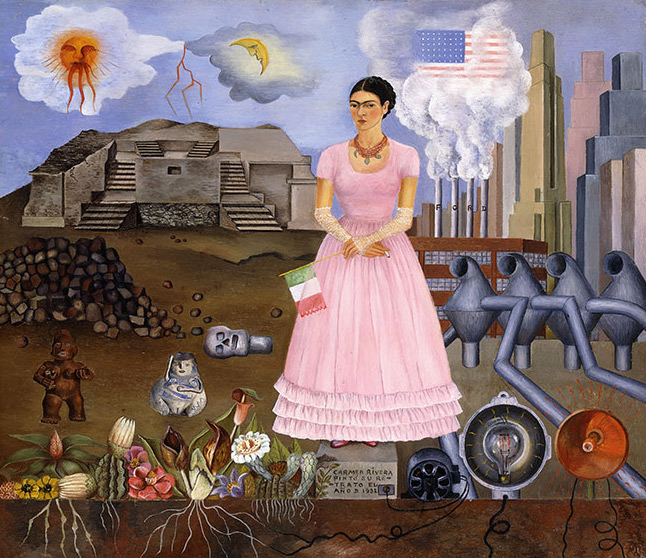
Self-Portrait on the Border Line between Mexico and the United States, 1932
Frida Kahlo, Mexican, 1907–1954
Oil on metal. 12 1/2 × 13 3/4 inches (31.8 × 34.9 cm)
Collection of María and Manuel Reyero, New York
© Banco de México Diego Rivera Frida Kahlo Museums Trust, Mexico, D.F. / VEGAP, Madrid, 2016
25 OCTOBER 2016 - 8 JANUARY 2017
PHILADELPHIA MUSEUM OF ART | PHILADELPHIA, USA
This exhibition will take a new and long-overdue look at the emergence, closely watched around the world, of Mexico as a center of modern art during a period of political upheaval and dramatic social change. Jose Clemente Orozco (1883-1949), Diego Rivera (1886-1957), and David Alfaro Siqueiros (1896-1974) have long dominated the story of modern art in Mexico, which has focused on their political engagement and the bold mural tradition they exemplified, and most standard accounts of the period have also included both Rufino Tamayo (1899-1991) and Frida Kahlo (1907-1954). Yet these renowned figures cannot be understood apart from the rich and fascinating history of innovation and aesthetic debate that unfolded over the course of four tumultuous decades, from 1910 until 1950, to which many other artists made significant contributions. This exhibition will survey the broad landscape—a panorama of competing cultural and artistic forces every bit as fierce as the struggles between the country's political factions—that gave rise to one of the most significant chapters in the history of modern art. It was at once inward looking—focused on the task of asserting a central role for art and artists in the process of redefining Mexico and its identity—and never before as fully engaged with artistic developments abroad.
In November 1910, an insurrection broke out against the 35-year regime of President Porfirio Diaz, ending an unprecedented period of political stability. Provoked by government repression, economic difficulties, and a presidential succession crisis, the rebellion activated broad segments of the Mexican public. The ensuing decade would be consumed by a bloody civil war. In 1920, former revolutionary general Alvaro Obregon assumed the presidency and began to rebuild the nation. When he put the distinguished intellectual Jose Vasconcelos at the helm of a new Ministry of Public Education (Secretaria de Educacfon Pdblica [SEP]), the visual arts took on an unprecedented prominence in the revolutionary national reconstruction. Vasconcelos assembled a network of painters to produce monumental murals in public buildings. These murals had a public and educative purpose: to commemorate Mexico's indigenous history and traditions, to narrate the struggles of the people since the Spanish conquest in the sixteenth century, and to depict the history and ideals of the insurgency.

Maya Women, 1926. Roberto Montenegro, Mexican, 1881–1968
Oil on canvas. 31 1/2 x 27 1/2 inches (80 x 69.8 cm)
The Museum of Modern Art, New York: Gift of Nelson A. Rockefeller, 560.1941
© VEGAP, Madrid, 2016
Mexico and Modern Art
The impact of the most progressive visual art being created in Europe was very important to young Mexican artists' self-definition as modernists. At the same time, they sought to imbue their own work with a distinctively Mexican consciousness—or mexicanidad—often involving the deployment of symbols of national identity. Dr. Atl (Gerardo Murillo [1875-1964]), a leader of the nascent Mexican avant-garde in the first several decades of the twentieth century, chose Mexico's iconic volcanoes and mountains as the subjects for his decidedly modernist landscape paintings. Likewise, Rivera, who spent the revolutionary decade in Paris, infused some of his cubist paintings with decorative motifs that are clearly Mexican in character. With compositions such as The Offering (1913), which depicts a family transporting marigolds to market on the Day of the Dead, a young star at the San Carlos art academy in Mexico City named Saturnino Herran helped to foster the imagery of the indigenous people of Mexico and of mestizaje—or the mixing of Indian and Spanish ancestries after the sixteenth-century Conquest of Mexico by Spain—which were powerful symbols of national belonging. All of these themes would be of great significance for modern art after the end of the armed phase of the Revolution in 1920.
Paint the Revolution
After 1920, the context in which Mexican artists worked shifted radically. The new government saw art as vital to the process of building a revolutionary state in the wake of a ten-year civil war. Mural painting came to the fore because it was architectural, monumental, and communal. The young muralists around Vasconcelos declared in their manifesto: the art of the Mexican people "is great because it surges from the people; it is collective, and our own aesthetic aim is to socialize artistic expression, to destroy bourgeois individualism." The message was not lost on thoughtful observers such as the American novelist John Dos Passos, who traveled in Mexico in 1926-27. He saw Rivera's mural cycles The Ballad of the Agrarian Revolution (1926-27) and The Ballad of the Proletarian Revolution (1928-29), which depict the social transformations ensuing from the Revolution and imagine Mexico's transition to a future socialist society, at the SEP headquarters in Mexico City. In an essay entitled "Paint the Revolution!" Dos Passos described Rivera's monumental work as a great challenge to the modern art in Paris and New York—a turn away from an essentially hermetic exploration of form and style and toward a renewed connection between aesthetic experience and public, political concerns.
The exhibition will examine the muralists' achievements through a range of masterpieces and key works in a variety of portable formats. It will also make unprecedented use of digital technologies to suggest the massive scale and complex imagery of three key examples of Mexican muralism: Rivera's The Ballad of the Agrarian Revolution and The Ballad of the Proletarian Revolution at the SEP; Orozco's The Epic of American Civilization (1932-34) at Dartmouth College in Hanover, New Hampshire; and Siqueiros's Portrait of the Bourgeoisie (1939-40) for the Mexico City headquarters of the Mexican Electricians Syndicate (Sindicato Mexicano de Electricistas [SME]). The use of digital technology is intended to convey the scale and immediacy of large public works that cannot themselves be presented in the exhibition.
Mural painting was hardly the only storyline of the art in the early post-Revolutionary period. The exhibition will also highlight the Education Ministry's efforts in art education as a means of cultural democratization. This effort was led by the painter Adolfo Best Maugard (1891-1964), who instituted a drawing method of his own for use in primary schools around Mexico City. A cohort of young artists including Tamayo, Abraham Angel (1905-1924), Augustin Lazo (1896-1971), Manuel Rodriguez Lozano (1896-1971), and Julio Castellanos (1905-1947), also engaged with this nationalist educational project and recognized the applicability of its methods and highly stylized imagery to the production of modern art. Similarly, future members of the Mexican avant-garde, including Rodriguez Lozano, Ramon Alva de la Canal (1892-1985), and Leopoldo Mendez (1902-1969), were connected with the socially inclusive Open-Air Painting Schools (Escuelas de Pintura al Aire Libre), which the modernists championed as alternatives to the traditional art establishment represented by Rivera and others.
International Connections
In the 1920s, two groups—both embedded in Mexico City's literary and artistic worlds—stood out for their advocacy of approaches to modernism that deviated significantly from the nationalist and traditionalist themes of mexicanidad. Stridentism, or Estridentismo, was born in December 1921, just as muralism's star was rising. A young poet named Manuel Maples Arce issued a manifesto proclaiming a new sensibility based on the chaotic beauty of modern life. "Let Us Become More Cosmopolitan," he declared. "We can no longer stick to the traditional chapters of national art." The artists who gravitated to Maples Arces's idea translated it in a multitude of ways. Alva de la Canal's cubist cafe scenes capture the group's urban orientation. German Cueto's (1883-1975) fiercely hued and grimacing portrait sculptures are icons of cultural aggressiveness. Images of cities, factories, and locomotives by Jean Chariot (1898-1979) and Ferrmn Revueltas (1901 -1935) capture the 1920s machine aesthetic.
The other group— a loosely structured network—came together in the first half of the 1920s. It found its name in the title of the Mexico City literary journal Contemporaneos (1928-1931). Painters such as Angel, Castellanos, Marfa Izquierdo (1902-1955), Lazo, Rodriguez Lozano, Roberto Montenegro (1885-1968), and Tamayo found their inspiration in modern French painting. The Contemporaneos journal promoted transatlantic modernism by publicizing connections between Mexico, the United States, and Europe. Unlike the Stridentists, the attitude of the Contemporaneos stood in sharp contrast to the spirit of revolutionary culture. They argued for the sensibility of the lyric and the individual rather than the epic and the collective. They were committed to art as an end in itself rather than as a political instrument—and they were attacked both by leading muralists and by members of the Stridentist group who linked their aggressive avant-gardism to socialist politics. At the same time, the Contemporaneos shared with the Stridentists a strong involvement with Mexican and international trends in modernist "New Vision" photography, which brought a selfconsciously artistic and experimental way of seeing both traditional and modern subjects. The exhibition will feature a selection of works by such photographers as Emilio Amero (1901-1976), Manuel Alvarez Bravo (1902-2002), Augustin Jimenez (1901-1974), Tina Modotti (1896-1942), and Edward Weston (1886-1958).
Mexican Artists in the United States
During the second half of the 1920s and in the early part of the next decade government sponsorship became relatively restricted. At the same time, in the United States, art dealers and museum curators celebrated Mexico as a rich, ancient American culture and an inspiration for the development of modern art. Universities and art patrons sought to demonstrate their enlightened attitudes by awarding mural commissions to Mexican painters, and leftist artists and intellectuals emphasized the social consciousness of contemporary Mexican art. Orozco moved to New York in 1927 and stayed in the United States for seven years. Rivera crisscrossed the country with Kahlo from late 1930 through 1933. Siqueiros, whose political and artistic activities kept him on the move across North and South America, was in Los Angeles in 1932 and then spent time in New York in 1934 and 1936, where he founded the Siqueiros Experimental Workshop, a studio for the investigation of new painting techniques. These sojourns produced remarkable images replete with the iconography of both countries. Some of the most striking examples—by Orozco, Rivera, Kahlo, Siqueiros, and others—highlight a common theme in different ways: the encounter between south and north, between Hispano- and Anglo-America. In this regard, Orozco's fresco panels for Dartmouth College are exemplary. They present an alternative narrative of the hemisphere's history—celebrating its ancient Mesoamerican origins—from an indigenous rather than a colonial viewpoint. Orozco defended the work as an "AMERICAN idea developed into American forms, American feeling, and, as a consequence, into American style."
Mexican Modernism and the World at War
The final chapter in the exhibition's account of Mexico's modernist artistic renaissance concerns the period from the prelude to the Second World War to its aftermath. In the later 1930s and early 1940s, both national and international developments reenergized the Mexican tradition of activist modernism. These included a socialist turn in Mexican politics during the presidency of Lazaro Cardenas (1934-40), combined with the impact of the Spanish Civil War and the advent of an international leftist and antifascist political coalition before and during World War II. Siqueiros called for a new populist art inspired by the age of the mass media. After his return from fighting on the Republican side in Spain, he and a team of assistants created a mural for the new headquarters of the Electricians' Union in Mexico City, Portrait of the Bourgeoisie. It imagines the Western industrial-capitalist system as a giant machine that mints coins from the blood of the common man while careening toward its own destruction. The populist spirit would also be taken up by members of the printmakers' collective Taller de Grafica Popular (TGP). The collective was founded in 1937 in a working-class Mexico City neighborhood by Leopoldo Mendez, a veteran of both the Open-Air Schools and the Stridentists, in cooperation with other leftist printmakers. This group created a flood of powerful graphic works—handbills, broadsides, posters, and artists' prints— that were strongly political in intent.
After World War II, a dual legacy emerged in Mexican art. Orozco and Siqueiros continued the didactic and politicized traditions of the prewar years in great compositions on themes of human conflict. Tamayo, on the other hand, shifted toward a more universalized mode of painting in line with international abstract painting. His Homage to the Indian Race (1952), a mural-sized painting, presents the perennial Mexican folkloric theme of the Tehuana flower seller in a monumental but highly abstract manner.
Paint the Revolution tells a story about the mutual impact of radical artistic developments and transformative social and political events and ideas. This story was both local and international in scope and remains central to our understanding of the development of modern art. It will highlight the extraordinary achievements of Mexican artists of this period and demonstrate their devotion to creating a modern art—and their success in doing so—that was deeply embedded in international politics and aesthetic currents, but was also rooted in Mexico's particular experiences, history, traditions, iconography, and institutions.
Support
Paint the Revolution is organized by the Philadelphia Museum of Art in partnership with the Museo del Palacio de Bellas Artes, Mexico City.
This exhibition is made possible by the National Endowment for the Humanities, the National Endowment for the Arts, the Robert J. Kleberg, Jr. and Helen C. Kleberg Foundation, PECO, Christie's, and The Mexican Society of Philadelphia, with additional support from G. Theodore and Nancie Burkett.
The catalogue for Paint the Revolution in English and Spanish is made possible by the Mary Street Jenkins Foundation. The English language edition is additionally supported by The Andrew W. Mellon Fund for Scholarly Publications at the Philadelphia Museum of Art.
Exhibition travel courtesy of American Airlines.
The Philadelphia Museum of Art is Philadelphia's art museum. We are a landmark building. A world-renowned collection. A place that welcomes everyone. We bring the arts to life, inspiring visitors—through scholarly study and creative play—to discover the spirit of imagination that lies in everyone. We connect people with the arts in rich and varied ways, making the experience of the Museum surprising, lively, and always memorable. We are committed to inviting visitors to see the world—and themselves— anew through the beauty and expressive power of the arts.
www.philamuseum.org/exhibitions/840.html
www.showonshow.com/philadelphia/2016/mexican_modernism/see/index.html


© 2003-2024 THE TRETYAKOV GALLERY MAGAZINE
All rights reserved
The materials of this site can be used in other web-sites only if an active link www.tretyakovgallerymagazine.com is provided
E-mail: art4cb@gmail.com
The site was designed by Tatyana Uspenskaya

