


Every month, MetCollects introduces one work of art recently acquired by the Met.
We invite you to have a first look with us.
Click below to go directly to this month's episode.
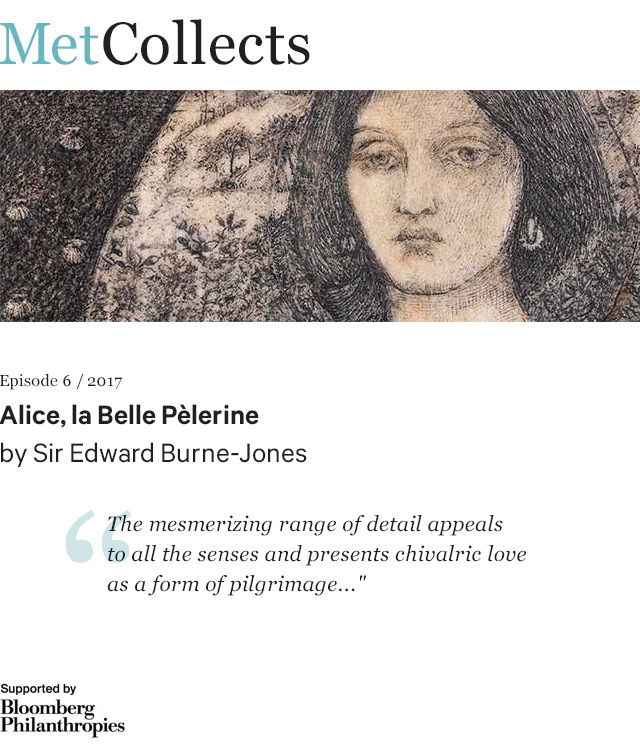
Burne-Jones uses fine ink lines to weave a mysterious image, Alice the Beautiful Pilgrim, a figure from Arthurian legend. Thomas Malory's Le morte d'Arthur (chapter 38) describes her as an heiress "passing fair" for whose hand the Knights of the Round Table avidly joust. We see Alice moving through a medieval interior, her head and shoulders framed by a lush landscape glimpsed through a masonry opening.
Made at the outset of the artist's career, this rare drawing comes from a small group that Burne-Jones devoted to themes of chivalry and romance from 1858. Three years before, while a theology student at Oxford, the twenty-two-year-old had toured French Gothic cathedrals with William Morris, then decided to abandon his degree and pursue art. Lessons from the Pre-Raphaelite Dante Gabriel Rossetti in 1856 exposed him to an unconventional vision of female beauty—prints by Albrecht Dürer, examined at the behest of John Ruskin, demonstrated how details could be at once realistic and symbolic—and Burne-Jones's fascination with medieval manuscript illumination encouraged his use of compressed space, dense patterning, and vellum as a support, all evident here in the Alice drawing.
Alice received her moniker "la belle pèlerine" from her father, Duke Ansirus the Pilgrim, who visited Jerusalem frequently. An emblematic scallop shell on a necklace establishes the connection, and the imagery reappears on the back wall and in a coat-of-arms adorning a companion's skirt. As in medieval sources, Burne-Jones enhances his chief subject's stature and dresses her richly, in a robe and cloak densely embroidered with flowers, peacock feathers, and other natural imagery. Even the delicate stitches on Alice's gloves are detailed, and her rare scent is evoked by a dangling pomander. A psaltry player leads the procession, two young companions bear their mistress's train, and a swirling banner at upper right suggests additional followers. The mesmerizing range of detail appeals to all the senses and presents chivalric love as a form of pilgrimage.


© 2003-2024 THE TRETYAKOV GALLERY MAGAZINE
All rights reserved
The materials of this site can be used in other web-sites only if an active link www.tretyakovgallerymagazine.com is provided
E-mail: art4cb@gmail.com
The site was designed by Tatyana Uspenskaya

