


© Garage Museum of Contemporary Art
Dear Friends,
May not only brings the first promise of summer to Garage, but also two new exhibitions. Opening on May 20, Congo Art Works: Popular Painting tells the fifty-year back story of colonial rule through to the present day, presenting artworks alongside historical objects and archival documents to reveal how popular painting is part of a continuum of image making that precedes colonization and evades Western categorization. Meanwhile, Kholin And Sapgir. Manuscripts makes public the documents, photographs, samizdat publications, and films relating to the poetry of Igor Kholin (1920–1999) and Genrikh Sapgir (1928–1999) for the first time, offering fresh insight into the work of two pioneers of Soviet nonconformist literature.
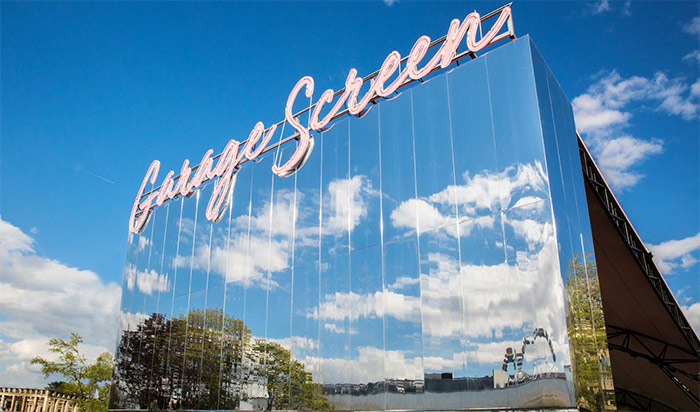
Coinciding with the exhibition openings, Garage will also host the second Art Book Fair featuring more than forty local and international publishers. A number of conversations and round table discussions will take place during the event, as well as a special series of screenings at Garage’s open-air cinema on the square in front of the Museum. Designed by the Milan-based architect bureau GRACE (Ekaterina Golovatyuk and Giacomo Cantoni), the new hang out will offer a full program of Russian and international films to make the most of Moscow’s long summer nights.
Please scroll down to see what else is in store this May at Garage.
All the best,

Kate Fowle
Garage Chief Curator
GARAGE EXHIBITIONS
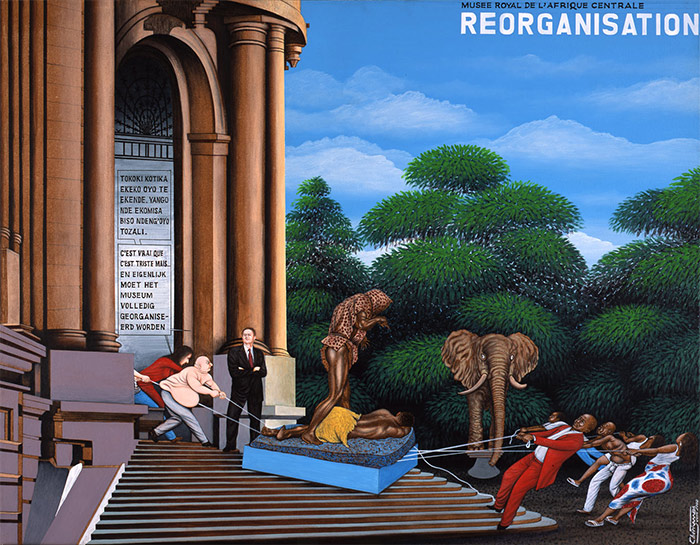
Chéri Samba, Reorganization, 2002, Oil on canvas, © RMCA, Tervuren
Congo Art Works: Popular Painting draws from the collection of the Royal Museum for Central Africa (RMCA) and tells the story of Congolese art from the times of Belgian colonialism to the present day. Popular painting is ingrained in the everyday life of the people of the Democratic Republic of Congo, reminding the viewer of recent colonial history, and offering satire and humorous fables about the human condition, all rendered in a colorful, conversational style that speaks to society directly.
The paintings are exhibited alongside historical objects of colonial times to question the western distinction between modern and traditional, ethnographic and contemporary, and present the history of popular painting as part of a continuum of image-making that precedes the colonization of Congo.
Congo Art Works: Popular Painting also includes two archival projects that underline contemporary uses of traditional Congolese art and its instrumentalization. Sammy Baloji, a Congolese artist and one of the two curators of the exhibition, addresses these questions with a conceptual intervention in the exhibition space. Based on the painted facade of a traditional courthouse made by the Mangbetu people—whose forms were highly appreciated by late-nineteenth-century colonists—Baloji’s work addresses questions of authenticity and the exoticization of Africans, as practiced by the Belgian colonial administration. A selection of advertisements, developed by artist Djo Bolankoko and based on the RMCA archives, demonstrates how popular painting as a practice is deeply inscribed in the urban fabric of Kinshasa.
In order to connect the exhibition and its exploration of colonialism and the post-colonial condition to the Russian context, Garage has developed a show within a show, which examines the art of Chukotka, a region in the Far East of the country that became part of the Soviet Union in 1920. With this investigation of a markedly different type of interaction between the metropolis and the margins, Garage seeks to address an important, but rarely examined topic.
Curated by Bambi Ceuppens of RMCA and Congolese artist Sammy Baloji.
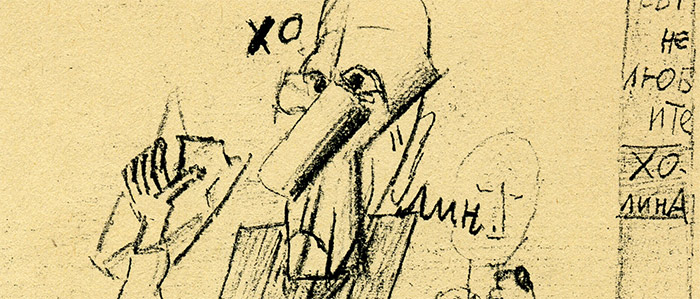
Igor Kholin. A copy of a drawing by Viktor Pivovarov. 1987, Viktor Pivovarov Collection of Garage Archive Collection, Moscow,
© Garage Museum of Contemporary Art
Igor Kholin (1920–1999) and Genrikh Sapgir (1928–1999) were members of the Lianozovo group, a loose-knit community of underground artists and writers which centered around artist Evgeny Kropivnitsky at his home in a barrack in Lianozovo, on the outskirts of Moscow. Although Kholin and Sapgir’s “poetry of the barracks” was not officially published until the advent of perestroika, it was distributed via samizdat (self-publishing) and became part of Soviet folklore, often quoted by people who had never read the original texts. Both poets found official work writing books and film scripts for children, and generations of Soviet children grew up reading their poems. Friends since 1952, and seemingly always together, Kholin and Sapgir are two key figures in the history of Soviet Nonconformist literature.
Kholin and Sapgir. Manuscripts features recent acquisitions from Garage Archive Collection, including previously unpublished manuscripts and limited edition books by Viktor Pivovarov, rare photographs, audio recordings, and video interviews. Animated films scripted by Sapgir and children’s books by both poets will also be presented.
PUBLIC PROGRAMS
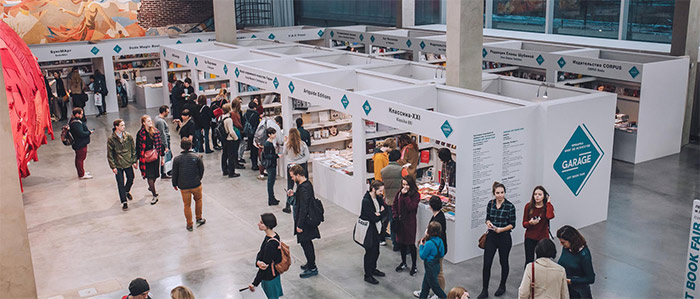
The first Garage Art Book Fair, Garage, October 2016, Photo: Anton Donnikov, © Garage Museum of Contemporary Art
The second Garage Art Book Fair takes place on May 20 and 21, featuring over forty publishers from Russia, the United States, and Europe, who will offer the latest titles on art and culture. Coinciding with Moscow’s annual Museum Night festivities—running through 11.59pm on May 20—visitors will have the opportunity to meet authors and editors as part of a program of talks over the entire weekend.
On May 20, Gilda Williams will discuss her book How to Write About Contemporary Art with Garage curator Valentin Diakonov, and dance historian Vita Khlopova will present Martha Graham’s autobiography, Blood Memory, the first volume in the new GARAGE DANCE series. On May 21, Mari Grinde Arntzen will discuss her book Dress Code: The Naked Truth About Fashion with writer and fashion expert Linor Goralik. From May 18, Garage’s new open-air cinema will present a series of films about the authors and subjects of books featured in the Museum’s co-publishing program with Ad Marginem Press.

Sky Ladder: The Art of Cai Guo-Qiang, Director Kevin Macdonald, 76 min. USA, 2016, Netflix
This summer, Garage Screen moves beyond the Museum to a new, open-air cinema on Garage Square in Gorky Park that opens to the public today, May 18, with Sky Ladder: The Art of Cai Guo-Qiang (2016), a film examining the work of Chinese contemporary artist Cai Guo-Qiang, who is famous for his gunpowder installations.
Since its launch in 2012, Garage Screen has brought viewers a wide range of Russian and international movies, documentaries, and experimental films. This year’s open-air screening program will run until September 10, focusing on documentaries and experimental movies, films at the boundary of cinema, and video art made by artists, as well as works of the past decade based on personal stories, historical and political research, and archival material.
Garage Screen is collaborating with leading Russian film festivals and Moscow cinemas such as Moscow International Film Festival, Documentary Film Center, and Beat Film Festival to produce more joint programs. All films are shown in their original language with Russian subtitles. The cinema is wheelchair accessible.
GARAGE ARCHIVE AND LIBRARY
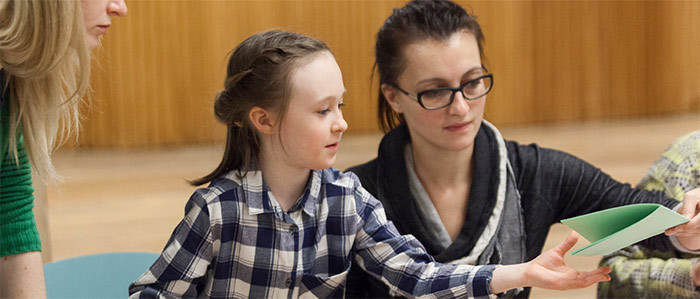
Make Your Own Book workshop, April 22, 2017, Garage Library, © Garage Museum of Contemporary Art.
A Make Your Own Book workshop for children and teenagers was held during the annual all-Russian Library Night on April 22 at Garage Library. The workshop was led by Pavel Smolin, a restoration specialist from the Nekrasov Library, who spoke to participants about basics of book printing and guided them through the creation of their own projects. Guided tours around Garage Archive Collection were held as a part of Library Night, conducted by Anastasia Tarasova, head of Garage Archive Collection. The events program closed with screening of the archive short-films Pushkin’s Manuscripts (1937, directed by Sergey Vladimirsky and Anatoly Egorov) and How Mayakovsky Worked (1947, directed by Viktor Morgenshtern and Fedor Tyapkin). The screenings were accompanied by a lecture from film scholar Petr Bagrov. Library Night at Garage Library was visited by nearly 200 people.


© 2003-2024 THE TRETYAKOV GALLERY MAGAZINE
All rights reserved
The materials of this site can be used in other web-sites only if an active link www.tretyakovgallerymagazine.com is provided
E-mail: art4cb@gmail.com
The site was designed by Tatyana Uspenskaya

